Showing posts with label 2014 Summer School. Show all posts

Monday, July 21, 2014

SUMMER SCHOOL BIOLOGY, 2nd SESSION, DAYS 9-11

The 'Cosmic Calendar' was due today (Monday, July 21st).   A Lecture Guide based on today's notes ("Darwin's Dangerous Idea") is due at the beginning of class tomorrow.   Students will be reviewing other applications of evolutionary theory, including primate evolution, in the morning session.   

In the afternoon, students will take their 200-point comprehensive course final.   Students are allowed to use their composition book notes, so make sure you not only bring your notes....but make sure they are complete!


Monday's Lecture Notes.

The title, incidentally, is taken from the Daniel Dennett book which also inspired a two-hour episode of the NOVA 'Evolution' series. We saw part of this episode in class yesterday, and will see another chunk on Tuesday morning, but I think students will benefit from watching the whole thing this evening.   

(For your convenience, I have embedded all 11 videos on this page, but these may not be visible on FUSD computers or on others that do not have recent versions of Java to run flash-based media.  If you are unable to open the individual videos on this post, go to the link above and watch them directly on YouTube)

Chapter 1. Prologue
Chapter 2. Common Ancestry


Chapter 3. Ecuador and the Tree of Life


Chapter 4. Natural Selection


Chapter 5. Mutation and HIV


Chapter 6. Complexity


Chapter 7. How The Eye Evolved


Chapter 8. God


Chapter 9. A Scientist Discusses Religion


Chapter 10. The Human Question


Chapter 11. Humans and The Tree of Life Chapter 12. Epilogue


Finally, here is the PBS web site that accompanies the entire series.
 
You can also watch parts of the videos there, but they are lower in resolution.


Thursday, July 17, 2014

SUMMER SCHOOL BIOLOGY, 2nd SESSION, DAY 8

THIS POST CONTAINS 2 (TWO) SECTIONS OF NOTES, EACH OF WHICH HAS A LECTURE GUIDE....

First up is the Power Point on "Diversity and Classification" can be uploaded here. The Lecture Guide, given in class today, based on the Power Point can be found as a PDF file here.


NEXT......The Power Point Lecture Notes on 'Deep Time' are available here. 


FACT: The fossil record (and other lines of evidence) show us that populations of living things have "changed over time" (evolved)....

QUESTION: How can we explain this pattern of change in terms of NATURAL causes?

* * * * * * * * * * * * * * * * * * * * * * * * * 

The article ("The Cosmic Calendar") is due on Monday the 21st .   No late submissions will be accepted.


The concept  is to display a "month" in an imaginary calendar that represents the history of our 13.7-billion-year-old universe:

 The original article that inspired this assignment was adapted from Carl Sagan's "The Dragons of Eden" and is available here.   
SUMMER SCHOOL BIOLOGY STUDENTS, PLEASE NOTE: you are not required to do a poster project based on this assignment, or submit any part to "Turnitin.com." In summer school, time does not permit that kind of detailed, multipart assessment. As discussed in class: read the article, answer the questions, do the math.   Get 'er done.


Monday, July 14, 2014

SUMMER SCHOOL BIOLOGY, 2nd SESSION, DAY 5


The Power Point Notes for Human Heredity are available here.


Students were given an activity that interprets diagrams like the one shown in the graphic above (a karyotype).   This is an online activity found at the University of Arizona.

Students were also given a worksheet based on the video below, shown in class in the afternoon session.   

It summarizes Mendel's discoveries, the work with fruit flies that demonstrated the role of the chromosomes, and 'connects-the-dots' between this early work and the next topic (biotechnology)....


Friday, July 11, 2014

SUMMER SCHOOL BIOLOGY, 2nd SESSION, DAY 4


A PDF of the Lecture Guide based upon the Power Point is available here.

During Friday's Biology classes, students were asked to complete a worksheet based on the video 'Cracking the Code of Life.'  The video viewed in class, and thus the handout based on it, can be viewed on-line here:


There is an entire PBS-sponsored web site to accompany this program. It's truly excellent, and since I can't show the entire program within a regular class, I wanted to make the whole thing available for students....

Thursday, July 10, 2014

SUMMER SCHOOL BIOLOGY, 2nd SESSION, DAY 2

Here is the (brief) Power Point discussing, and giving examples of some basic principles of probability. This is, of course, math....but an essential tool, also, for doing science.


Tuesday, July 8, 2014

SUMMER SCHOOL BIOLOGY, 2nd SESSION, DAY 1

This is the first post from the first day of the second session of Summer School Biology (July 8-July 22).   Students began this session learning course policies and class rules, then had refresher notes on scientific method:


Students! Here is the Power Point for the notes on 'The Nature of Science'. You will receive a Lecture Guide based on these Notes sometime this week! If you don't have Power Point on your computer, don't worry . . . you can download a free program, Power Point Viewer, to see the notes!

KEEP IN MIND...this summer, in Mr. Hatfield's Classes, we will try to reduce the amount of class time spent taking notes. There are dozens of standards to cover, hundreds of vocabulary terms and other items to master. We need to decrease the amount of time spent in lecture so students can have more time to do activities. Remember: we want to engage as many different parts of the brain as possible, and to do that, we need to have more time to do things other than notes.


At the same time, your Cornell Notes must be complete (all the notes, original questions and comments in the margins, your name/date/course on every page, and summaries of major sections of notes). Therefore, it is the student's responsibility to download and complete any notes that they were not able to finish in class!!

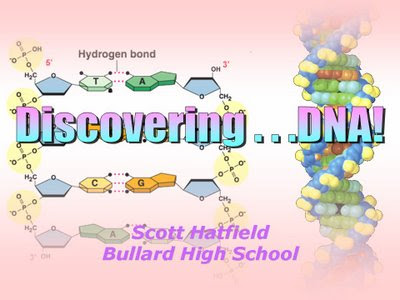
Here are the Power Point notes on DNA and RNA from Chapter 12 of the text.   This material was previously covered in the last three days of the first session of Summer School Biology.   It is recapitulated in this session in part because it is very challenging, and in part because some aspects of DNA structure and function, as well as transcription and translation, is needed to understand aspects of genetics, biotechnology and evolution....

. These Power Point notes are available for download here.

Monday, June 30, 2014

SUMMER SCHOOL BIOLOGY, DAYS 9-10

The Power Point summarizing the Cell Cycle, based on the first two sections of Chapter 10, is available here:


These notes were given Monday in both the morning and afternoon sessions. These Power Point notes are available for download here.


Students are allowed to use their composition books on the day of the final, but they must be submitted in the final 20 minutes of instruction.  Students should strive to complete their notes, with questions and comments in the margins, underlining and/or highlighting of major points, color in any drawings or diagrams, etc.   This provides evidence that students both reviewed and personalized their notes.  

Students who provide this evidence will earn points on the final day of instruction, students who fail to do so will lose points.

Thursday, June 26, 2014

BIOLOGY SUMMER SCHOOL, DAYS 7 and 8

This Power Point contains an outline of photosynthesis, relating it to the 'Great Circle' of chemical reactions that all living things participate it (autotrophs and heterotrophs!), reactions which recycle the raw materials that life requires. Much of this material is covered in the first two sections of Chapter 8 in the Dragonfly Book.


The Power Point for Photosynthesis, Part I, is available here.

A PDF file of the Lecture Guide based on that Power Point can be downloaded here.

Cellular Respiration: This Power Point contains information about cellular respiration, including glycolysis (which takes place in the cytoplasm) and the Krebs Cycle (which takes place in the matrix of the mitochondria). The electrons produced in the Krebs Cycle move through the inner membrane, or cristae, of the mitochondria. The motion of these negatively-charged particles attracts protons (H+), and eventually a high concentration of protons within the membrane is available to drive 'proton pumps' that power an enzyme, ATP synthase, leading to the production of more ATP:


You can download the actual Power Point here.


Tuesday, June 24, 2014

BIOLOGY, SUMMER SCHOOL, DAY 6

The following post contains a link to the latest set of Cornell Notes in Mr. Hatfield's classes.  These include the structure and function of the neuron, the type of cell that makes up most of the tissues in the nervous system.

https://www.mediafire.com/?qe16imv74age7qe


Here are the notes on neuron structure and function.    Today's class built on yesterday's notes on cells and their organelles

The morning session focused on cell membrane structure and function, with special attention to how the neuron uses its membrane to create a difference in electrical potential, which becomes the basis of the nerve impulse.   At the end of class, students were shown a 20-minute video which describes some of the events that take place in the development of a human infant's brain.   A worksheet based on this video was distributed in class.

Here is that video, broken into a pair of segments:


Students who are interested in watching other videos in this series can find them on the following YouTube channel: 

https://www.youtube.com/user/flixwest?feature=watch


And, just in case you lose the worksheet given in class, a PDF file copy is available HERE.


Students: The ACTION POTENTIAL, covered on pages 898-900 of your text, is one of the more challenging topics in the course, but a very effective way of illustrating aspects of cell membrane function.

To assist with your understanding for Wednesday's class, here is a video, shown in class, that summarizes the events in a single action potential:


Notice that the resting potential is negative (-70mv) while the action potential is positive (+40mv).

Notice that the change in potential is generated by the motion of positively-charged sodium (Na+) and potassium (K+) ions across the axon membrane.

Before the nerve fires, sodium is in high concentration OUTSIDE the axon membrane, while potassium is in high concentration WITHIN the membrane.  In the video, the sodium channel is shown in green while the potassium channel is shown in blue.   There are also 'leak' channels shown in purple.

The graph shown in the video is commonly used in college-level courses to convey a great deal of information about the various stages of the action potential (resting potential, depolarization, repolarization, hyperpolarization, etc.) and uses significant vocabulary and concepts not found in your text.   You will not be responsible for knowing the graph, but as it may help you to understand the concepts behind the video, I enclose a version of that graph here:  


Monday, June 23, 2014

BIOLOGY, SUMMER SCHOOL, DAY 5


Here's the link you need to download this Power Point, to use to complete your notes or the Lecture Guide based upon it.


You can get the Power Point for 'The Fluid Mosaic Model of the Cell Membrane" here. There are drawings in Chapter 7 of your text, particularly the one on pg. 182, that would be good for students to have completed in their notes. Mr. Hatfield, as always, recommends that students use colored pencils to improve their drawings.

Friday, June 20, 2014

BIOLOGY SUMMER SCHOOL, DAY 4

Here is the Power Point on 'The Chemistry of Life.' Students received a Lecture Guide based on these notes during Friday's class.  It is due at the beginning of class on Monday.   They should use that Guide to compare the notes in their composition books with the Power Point notes.

Wednesday, June 18, 2014

Tuesday, June 17, 2014

BIOLOGY SUMMER SCHOOL, DAY 1

Summer School Biology students today viewed a 36-minute IMAX video in class and completing a worksheet based on part of the video. The film, 'Cosmic Voyage', was made in 1996 for the Smithsonian Institute and was clearly inspired by a classic science education film called 'Powers of Ten', originally produced in 1977 by the husband-and-wife team of Rae and Charles Eames.

'Cosmic Voyage' approaches the idea of using the metric system, which is based on powers of ten, to explore the question: "What is really large, and really small?" The film first zooms out from an acrobat's ring in St. Mark's Square in Venice, the place where Galileo first trained his telescope on the heavens.


Through 23 powers of ten, we leave first the Earth, then our solar system, then the Milky Way Galaxy behind, until we reach the limit of modern astronomy, where we can see images from about 13 billion years past.


Reversing course, the video then zooms in on drop of water in the Dutch town of Delft, where Antonie Van Leuuwenhoek first trained his early microscope to discover the hidden world of microbes.


As we zoom in on a paramecium, we penetrate its cell nucleus, then zoom in on a molecule of DNA.


Within that molecule is a carbon atom, and the world within that atom is mostly empty space! Within the atom, the atomic nucleus contains virtually all of an atom's mass, made of particles called protons and neutrons. These, in turn, are formed from even smaller particles called quarks.

The film continues with a discussion of the search for a fundamental theory in physics through the use of particle accelerators like Fermilab, along with an overview of the likely "recent" events that led to our sun, our solar system, the Earth and life itself.

Here, presented on YouTube, is the first segment (Chapter 1) of the film who wish to review the material or share it with others. As the narrator (Morgan Freeman) intones, 'we are all travelers on a voyage of discovery!' Chapter 2, Chapter 3 and Chapter 4 can be assessed at YouTube directly or by clicking on the hyperlinks.

Meanwhile...


Students! Here is the Power Point for the notes on 'The Nature of Science'. You will receive a Lecture Guide based on these Notes sometime this week! If you don't have Power Point on your computer, don't worry . . . you can download a free program, Power Point Viewer, to see the notes!

KEEP IN MIND...this summer, in Mr. Hatfield's Classes, we will try to reduce the amount of class time spent taking notes. There are dozens of standards to cover, hundreds of vocabulary terms and other items to master. We need to decrease the amount of time spent in lecture so students can have more time to do activities. Remember: we want to engage as many different parts of the brain as possible, and to do that, we need to have more time to do things other than notes.


At the same time, your Cornell Notes must be complete (all the notes, original questions and comments in the margins, your name/date/course on every page, and summaries of major sections of notes). Therefore, it is the student's responsibility to download and complete any notes that they were not able to finish in class!!


THE NATURE OF SCIENCE